Take the Weight Off: The Names and Stories Behind Quorndon's Memorial Benches
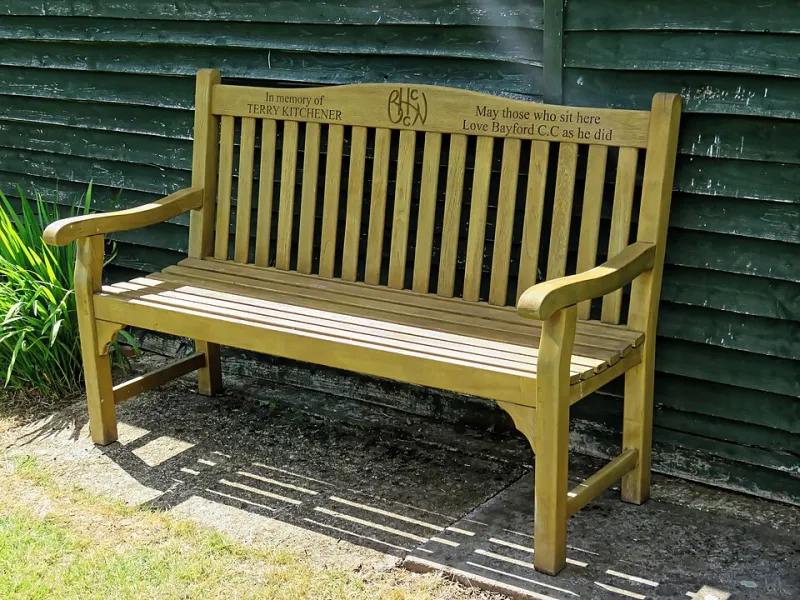
Photo: Acabashi, CC BY-SA 4.0, via Wikimedia Commons
There is a bench in Quorndon that almost nobody sits on, because it is facing the wrong way. It looks across a hedge rather than along the view, and every year somebody mentions it, and every year nothing is done. I have come to rather love it. It is a monument to good intentions, and villages are full of those.
Memorial benches are the quietest kind of local history. No plaque on a wall, no unveiling with a photographer from the paper — just a name, two dates, and a seat at a particular height in a particular place. Over the past few weeks I have walked the village with a notebook, stopping at every one I could find, and what follows is part field guide, part small act of thanks.
A bench is a small building with a large job
Think about what a bench actually does. It holds a person up when they are tired. It gives a teenager somewhere to sit that isn't a shop doorway, and a widower somewhere to sit that isn't a kitchen chair. It provides a place to wait, to think, to eat a sandwich, to have the conversation you could not have while walking.
And then, with a small brass plate and four screws, it stops being street furniture and becomes a person. That is quite a transformation for a piece of timber.
The seat above the park
The bench on the rise above the recreation ground has one of the best views in the village, especially in November when the trees have thinned out and the light comes low across the rooftops. The plate on it is simple: a name, a date of birth, a date of death, and the words 'he liked to watch the cricket'.
I have thought about that line more than any other inscription in Quorndon. It tells you nothing and everything. Somebody chose, out of all the words available, to record that this man enjoyed sitting here on a summer evening watching village cricket, and that is now the thing the village knows about him. There is a gentleness to that which I find hard to describe without sounding sentimental. So I will simply say: it is a good way to be remembered.
Brass, teak and the English weather
Before the plaques, there is the wood, and the wood has a story too.
Most of the benches you will find around the village are teak, or something that has been passed off as teak at some point in the last forty years. Teak is hard, oily and stubborn, which is why it survives decades of Charnwood weather while the cheaper benches quietly rot from the legs up. The parish has replaced slats on some seats more than once, and there is a small perennial conversation about whether to switch to a recycled plastic alternative which would last forever and which nobody quite wants, because it doesn't feel right under the hand.
Then there is the brass. Plates fade and tarnish and get polished by people who never met the person named on them, which is its own small act of devotion. Some inscriptions are formal. Some are funny. One that has always stayed with me, though not in Quorndon, reads simply: 'Better here than in the house.'
Who keeps them going
Benches do not survive by accident. They survive because a family member rings the parish once a year to ask whether the seat is still sound, or because the lengthsman notices a wobble in the spring and reports it, or because someone in the village takes a tin of wood preserver out on a dry Saturday in September and does a job nobody asked them to do.
There is a quiet etiquette to all this. If you see a bench with flowers tied to it on an anniversary, you leave it alone. If a plate comes loose, you tell someone rather than tightening it yourself. If you sit down and find the seat wet, you wipe it with your sleeve and think nothing of it, because that is what sleeves are for.
The unwritten rules of a good seat
The best benches, I have decided, obey four rules.
One: it faces something worth looking at, and not a hedge. Two: it has a back, because a bench without a back is a perch and a perch is for waiting for a bus. Three: it is close enough to the path that you can reach it in slippers but far enough that you are not in the way of the dog walkers. Four: it is positioned, whether by luck or design, where people pass — because half the point of a bench is not the sitting, it is the being available for a chat.
That last one is the thing I would gently argue for. When the parish next considers where a new seat might go, the view matters less than the footfall. A bench in a beautiful spot that nobody passes is a nice idea. A bench on a well-used path is a small piece of social infrastructure, and we have never needed those more.
The bench you can't quite remember
Here is the odd thing about memorial benches: most of us use them without ever reading the plate. We sit, we eat our lunch, we go. The name underneath is invisible until the day we stop and look.
So this month, if you are out and about and the weather gives you half an hour, pick a bench you have never properly looked at and read it. You will find a birth year in the 1920s, or a name that appears twice on two different seats, or a date that turns out to be the year the bypass opened. You will find, in other words, the village's memory written at knee height, in brass, in the open air.
Your seat, your story
We would very much like to hear from you on this one. Which bench in Quorndon do you think of as yours? Where did you have the conversation you still remember? Is there a seat that has gone, one you miss, one where somebody proposed or somebody scattered ashes or somebody simply sat every morning at half past seven with a flask?
Write to us — we read everything, and we would love to build a proper map of the village's favourite resting places, plaque by plaque. In the meantime, the light is low, the leaves are down, and there is a bench above the park with your name on it. Well. Not literally. But you know what I mean.