Seven-Fifteen at the Glass Hut: The Quiet Theatre of Quorndon’s Morning Bus Stop
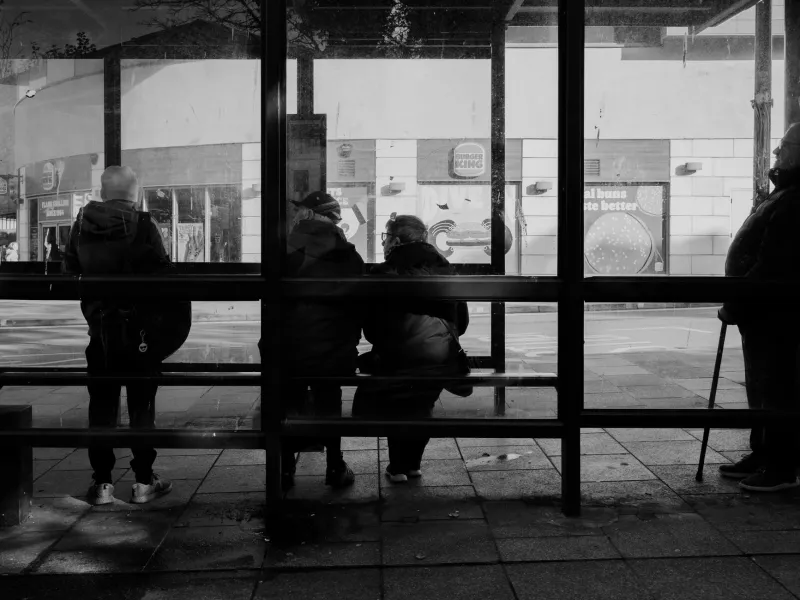
On a damp Tuesday morning this November, the 127 is not due for another eleven minutes, but the glass shelter on the corner is already half full. Margaret has claimed the left-hand bench and is explaining, with some feeling, that the pharmacy has moved its queue indoors. Derek is nodding over a folded newspaper. Aisha is leaning against the timetable, holding a flask as if it were a small dog. None of them needs to be there yet. That, as much as the timetable, is the point.
The shelter is not grand. It has three glass walls, a metal bench that is colder than it looks, a bin, and a timetable that someone keeps in a plastic sleeve. There is no plaque, no coffee machine, no official greeter. Yet for a stretch of twenty minutes each weekday, it becomes the village’s most reliable social club — a place where you can arrive alone, say nothing, and still leave with the feeling that you have been somewhere.
The first arrivals and the unspoken seating plan
There is a seating plan, though nobody would admit it. The left end of the bench belongs to the early regulars, the ones who arrive before seven and treat the shelter like a front room with a bus attached. The right end is for people with shopping bags, school rucksacks or a reluctance to be drawn into conversation before eight. The corner perch, where the glass meets the frame, is for teenagers who would rather not be seen waiting with their parents. Nobody enforces any of it. It simply works, the way most village things do.
By ten past seven, the cast has usually assembled. Margaret brings the weather report, not from an app but from her own inspection of the sky over the churchyard. Derek brings the headlines, summarised with a raised eyebrow. Aisha brings the flask, which she shares with anyone who looks cold enough. There are others — the man who cycles halfway and then catches the bus, the woman who walks her daughter to the stop before school, the retired teacher who knows everyone’s dog by name. The 127 is the reason they are there. The conversation is the reason they arrive early.
A timetable is only half the story
The 127 runs to Loughborough and back, and it has done so, in one form or another, for longer than most of the shelter’s regulars care to remember. The bus itself is not the attraction. It is the waiting that has been quietly repurposed. In the shelter, you learn things. You learn that the road outside the school floods if it rains hard enough. You learn who has a ladder, who has a spare key for the church hall, and who is willing to take in a parcel for a neighbour. You learn that the bin is emptied on a Tuesday, that the timetable case needs a new elastic band, and that the woman in the red coat makes excellent marmalade.
It is a noticeboard with legs. Announcements are made, questions are asked, and small problems are solved before the bus has even rounded the corner. When a newcomer moved into the cul-de-sac last month, she was advised on bins, buses and the best day to visit the tip before she had finished her first coffee. Nobody organised this. It happened because the shelter gives people somewhere to stand that is not their own doorstep and not quite public property either.
What the glass remembers
The shelter has seen a few versions of itself. Older residents remember a wooden hut with a bench worn smooth by decades of waiting, a timetable behind scratched plastic, and the particular thrill of a printed return ticket. There was a time when the bus conductor knew the stops by heart and the queue formed in a neat, self-conscious line. The glass hut that stands there now is newer, brighter and easier to clean, but it has inherited the same job. It is a place for the in-between parts of the day.
You can see that inheritance in the small rituals. Someone always checks the timetable when they arrive, even though they know the 127 comes at twenty-three minutes past. Someone always stands up when an older neighbour approaches, then pretends they were stretching. Someone always says “mind the step” as the bus pulls in, even though the step has not changed in years. These are not grand gestures. They are the sort of thing that makes a timetable feel less like a timetable and more like a promise.
Weatherproof friendships
In winter, the shelter is a refuge. The glass fogs up, the bench gets a bloom of condensation, and the conversation turns to gritting, gutters and the price of heating. In summer, it is too warm to sit in, so people gather outside in a loose semicircle, using the shelter as a backdrop rather than a room. Either way, the same rule applies: you do not have to be sociable to belong. You just have to be going the same way.
That rule is tested on difficult mornings. If someone is quiet, the regulars talk about the weather until they are ready to talk about something else. If someone is upset, a mint is offered, a seat is saved, a bag is moved. The shelter does not fix anything. It simply holds a space where a neighbour can be seen. In a village that is always half-rushing, that is no small thing.
The 127 as a moving front room
When the bus finally arrives, the shelter empties in a shuffle of coats and carriers. The driver nods at Margaret, who nods back. Derek folds his newspaper. Aisha caps the flask. For a moment, the chat continues on the pavement, then it moves up the steps and into the aisle, where it settles into the familiar rhythm of a moving front room. The shelter stays behind, holding the warmth of a dozen small exchanges.
By the evening, the cast changes. The 5:40 brings home the people who left at seven, plus a few new faces. The shelter is quieter then, more reflective. Someone might mention the sunset. Someone might mention a parcel that needs collecting. The conversation is shorter, but it is still there. The glass hut on the corner does not close. It simply changes shift.
Why the unglamorous places matter
Quorndon has its share of photogenic corners — the church, the green, the pub windows glowing on a cold night. The bus shelter is not one of them. It is the sort of place you pass without seeing, unless you are waiting. But that is exactly why it matters. It is community without a committee, neighbourliness without a newsletter, a chat room with a timetable. It asks nothing of you except that you turn up.
So this November, if you find yourself at the corner with a few minutes to spare, step inside. Check the timetable. Say good morning. You may leave with a bus, or you may leave with a recommendation for a plumber, a recipe for marmalade and the name of someone’s dog. Either way, the 127 will be along shortly. And the village, in its quiet, glass-walled way, will keep talking.