The Postbox That Wears Its Heart on Its Sleeve: Quorndon's Quiet Yarn Mystery
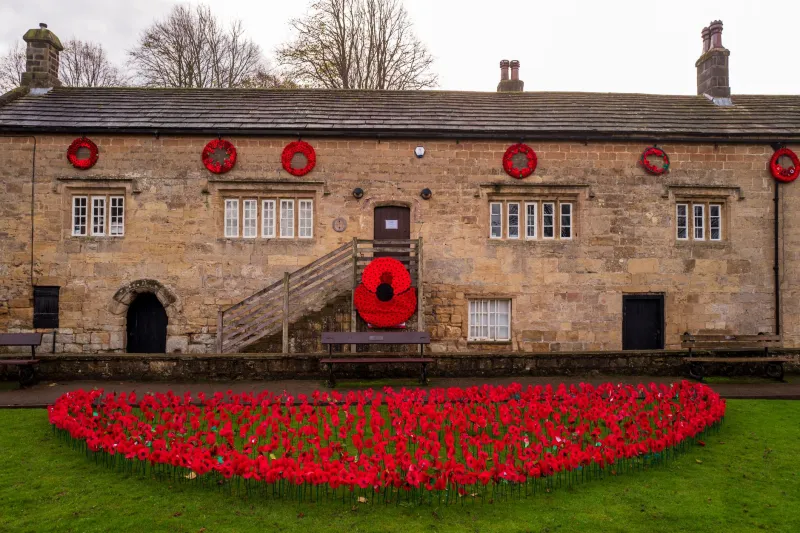
On a grey November morning, the postbox at the top of Quorndon's village green is wearing poppies. Not a single plastic pin, but a thick band of knitted blooms, stitched together and fitted snugly over the red metal. It is the sort of thing you notice from twenty paces and then, if you are sensible, stop to look at properly.
The topper has been there for a few days now. Nobody seems to know exactly who put it there. That, in itself, is part of the pleasure. In a village where most good deeds come with a name attached — the person who runs the coffee morning, the neighbour who takes in parcels, the volunteer who opens the hall — this one arrives without a bow. Or rather, it arrives with several bows, but no signature.
A postbox with a wardrobe
Over the past few years, the toppers have become a quiet calendar. Spring brings lambs, daffodils or something egg-shaped. Summer has bees and strawberries. Halloween gets bats and pumpkins. Christmas, inevitably, gets a full festive scene, complete with a tiny knitted postbox of its own. The current poppy display is the most solemn of the year, and it lands on Armistice Day with a gentle sort of weight.
Nobody officially commissioned any of it. The toppers are temporary, tied on rather than glued, and removed before they fray. They are not a council project, a tourism campaign or a Royal Mail initiative. They are simply a gift from someone in the village to everyone else who passes by.
And they have become a landmark. People arrange to meet 'by the postbox with the woolly thing on it'. Children ask what the topper will be next. Dog walkers slow down. Someone has clearly worked out that a postbox is one of the last truly public bits of street furniture — a place you can stand beside without buying a coffee or explaining yourself.
The needles behind the wool
The obvious question is: who? The short answer is that nobody will say. The longer answer is that a handful of people are involved, and they would rather the attention stayed on the wool. You will hear them called 'the yarn bombers', 'the postbox ladies', and, from one small child, 'the ones who dress the letter box'. None of these is official.
What is clear is that this is not a solo operation. The toppers are too detailed, too carefully fitted and too regularly changed for one pair of hands alone. There is talk of a small group, perhaps six or seven, who meet in kitchens and front rooms with the kettle on and a pattern that someone has adapted from a magazine. There is also talk of a wool stash that has got out of hand, which is the most believable detail of all.
The response, when I asked around, was friendly but firm: it is not about them. The knitters do not want a plaque, a photo call or a name in the paper. They want the postbox to look nice. That is the whole brief. In a world where so many good deeds come with a hashtag, there is something quietly refreshing about a project that would rather you just enjoyed the poppies.
Why wool works
Yarn bombing has a slightly rebellious name for something so wholesome. In practice, it is closer to guerrilla gardening with needles. It appears overnight. It is soft, removable and unlikely to damage anything. It does not ask for permission, but it does not leave a mess either. Unlike paint, you can take it down when the weather turns. Unlike a plaque, it does not need a committee.
The poppy topper is a good example of how much can be said with very little. It is not showy. It is dozens of individual blooms, each one slightly different, stitched together in a way that rewards a closer look. For anyone who has stood at the war memorial on Remembrance Sunday, the postbox feels like a smaller, quieter companion to the service. It does not compete. It just adds its own small mark of respect.
Then, in a week or two, it will vanish. A Christmas topper may take its place. The poppies will be packed away, and the postbox will go back to being a postbox. That ephemeral quality is part of the charm. You cannot buy a ticket to see it. You cannot scroll past it. You have to be there, in the village, on the right day.
A village noticeboard in wool
What the toppers really do is start conversations. Neighbours who might otherwise only nod at each other stop to admire the same bit of knitting. Someone asks who made it. Someone else says they have heard it is a group from the other end of the village. A third person says they saw a similar one in Woodhouse Eaves and wonders if it is the same people. Nobody knows, and that is fine.
It has also become a low-key barometer of village mood. The poppy topper feels reflective. The Christmas one feels cheerful. The Halloween one, with its tiny bats, feels like a joke shared between neighbours. None of it is official. All of it is noticed.
Perhaps the nicest thing about the toppers is that they are not trying to sell anything. There is no QR code, no sponsor, no council logo, no invitation to follow an account. It is just wool, time and a bit of imagination. In a village that is changing like everywhere else, that feels like a small act of continuity.
A quiet invitation
If you want to say thank you, the best thing is probably to keep it simple. Admire it. Take a photo. Tell a neighbour. Do not tug at the stitches, and do not try to add your own contribution without checking — the group apparently keeps a careful eye on fit and weather. The toppers are made to survive a Quorndon November, not a well-meaning extra bow.
Whoever is behind the wool has given the village a small, recurring gift. It does not ask for a follow, a like or a subscription. It just asks that you look up from your phone for a second. On Armistice Day, with the poppies bright against the red, that feels like a very good ask indeed.
So next time you post a letter, take a moment. The postbox is wearing its heart on its sleeve. And somewhere in Quorndon, a pair of needles is already clicking towards the next occasion.